


The painting world of Giuseppe Siniscalchi
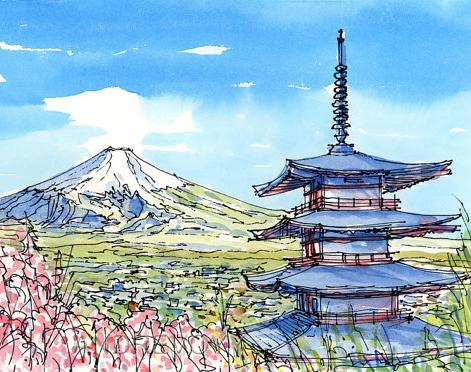 The italian painter Giuseppe Siniscalchi is facing a series of paintings where the japanese and western traditions are mixed togheter.
To talk about Giuseppe I first of all need to tell you an anedocte. I was in my third class (1950) and during the lecture of western history the teacher told us about Francesco Petrarca and his famous quote after climbing a mountain: “The mount is under my feet”. The professor added that this example is the perfect symbol of the dominion of men over nature. At that time I thought that this quote was fantastic and that, in the Renaissance, the Western civilization managed to obtain enormous material benefits for mankind. In those years, Japan was following the idea of copying the European model and overcome it, shaking traditional japanese values.
In 1956, when the lust for reconstruction was heading towards its limit, the japanese climber Maki Aritsune reached the top of mount Manashu on the Himalaya. And his point of view was very different from the one of Petrarca:. In his diary he uses the words “to be embraced by the mountain”, expressing a deep symbiosis without contrast with nature. It is the 和 (WA), the deep feeling that flows in the veins of japanese culture. Reading Aritsune’s text moved me and since then I cannot avoid having some kind of reject for Petrarca’s quote. There my japanese identity was born. We are more and more losing our relationship with nature and between each other. We cannot close our eyes anymore in front of the spiritual famine of our times, full of instability and loneliness.
Will there ever be a way out of this crisis?
In a recent meeting, Giuseppe Siniscalchi showed me some of his paintings and told me about my artistic vision: I immediately thought about the Petrarca-Aritsune anedocte. The fact that Giuseppe, compatriot of Petrarca, is looking for a fusion between japanese and western art filled me with joy. It is a concrete opportunity to get out of the spiritual crisis in which today’s men are prisoners.
My first meeting with Giuseppe and the japanese sculptor Kenjiro Azuma was indeed in 2011 at the Museo della Scienza e della Tecnologia in Milan. From then on Giuseppe started growing an interest in japanese culture and searching for a form of painting where the japanese 和 (WA) could find expression. His wonderful bride, born in Joetsu, contributed as well.
The subjects of Giuseppe’s paintings go beyond any national, cultural or ethnic difference. They belong to a cosmic atmosphere, where the relationship between the human being and nature can be breathed continously. It is a symphony of the eternal richness of cosmos and human precariousness. In Giuseppe’s paintings everything is 環 (WA), united in a round binding, without cracks. A demand for peace for the whole world. The two ideograms, 和 (WA) e 環 (WA) – different but with the same pronunciation – have a connected meaning. Everything makes me think that Giuseppe knows that.
His paintings have a very simple structure. No technical devices, only the essential is represented, but with so many underlying references in contemplations. I would like to talk a little bit of one of his paintings in particular. In the center we can find a gracious woman with oriental looks, while on top the moon lights up the scene with a palely. The hands and feet of the subject are grounded in earth as if it was born from the womb of nature: joined with earth, daughter of earth. Beyond time and space, we are one with the cosmos. This is the call coming from the 和 ideogram painted over the hat.
From this painting I could not avoid thinking also about the 能 (NŌ) ideogram of the japanese theatre tradition. The reason is that in the 能 (NŌ) theatre there is no break between past, present and future. Set design are very simple, faces are covered by masks, sound is surreal. With the name ofTakigi Nō – the Nō of firewood – the Nō is exhibited also outside. In some ways, the 能 (NŌ) is where nature and cosmos meet up. All living beings are joined in the round link of the 環 (WA). That is why I recognize that there is something comunicating with 能 (NŌ) in Giuseppe’s paintings.
His effort to harmonize japanese and western art can only be animated by 和 (WA), universal peace. It is also a prayer for peace in the whole world. I therefore hope that his activity will go on in the future, to free us from the spiritual famine that mankind is going through.